One system for spend, bills and the close.
Issue the card, capture the receipt, pay the supplier and close the month —without moving the same numbers between four systems.

March · to date
0 uncoded€431,300
- Card spend
- €182,400
- Supplier bills
- €248,900
How it works
Issue, capture, reconcile.
Three steps, one ledger.Every card swipe, supplier bill and journal entry lands in the same place —coded as it happens, not chased at month end.
•••• 4471
Engineering
Virtual · €2,500 cap
Issued in 0.8s1IssueIssue a card in seconds.
Physical, virtual or single-use. Limits and merchant categories are set as policy, not chased per purchase.
Card issued · Engineering
Receipt captured
Carta Office · €48.20
Coded · 4010 Software
2CaptureCapture at the till.
The cardholder is prompted the moment the transaction lands — VAT and cost centre come back with it.
94% captured same day
Bank feed
€48.20
Ledger 4010
€48.20
3ReconcileReconcile continuously.
Every line is already coded and matched against the bank feed, so the close is a review rather than a rebuild.
Day 21 → day 3
The three pillars
Three products. One ledger underneath.

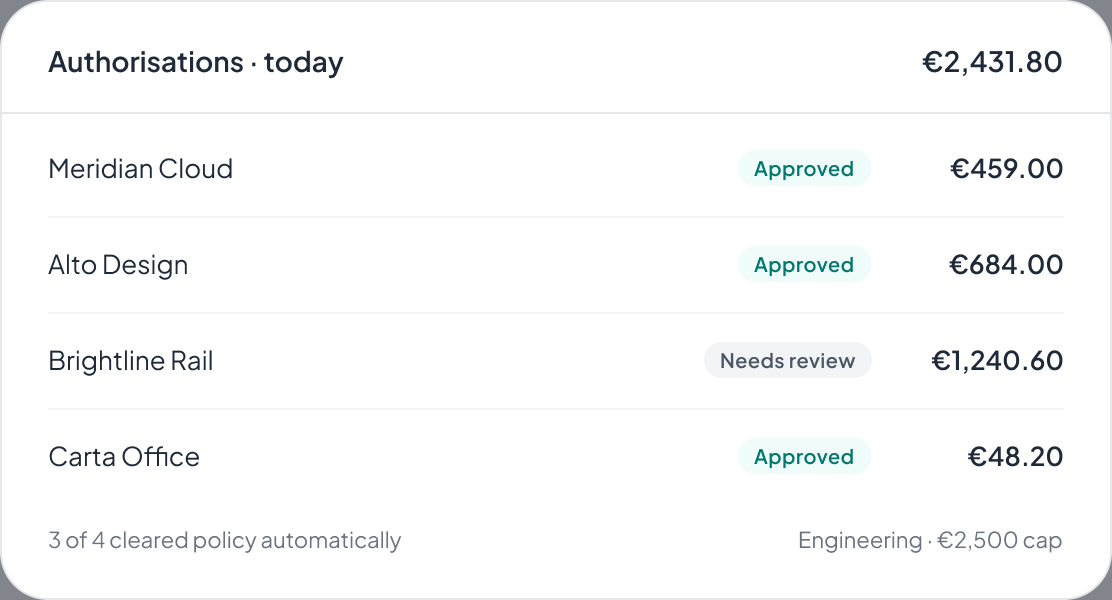
Cards that carry their own policy.
Issue physical, virtual or single-use cards in seconds.Limits, merchant categories and approval thresholds live on the card itself, so finance reviews the exceptions instead of every purchase.
92% of card spend needs no review
Measured across 2,400 teams in the first quarter after switching.

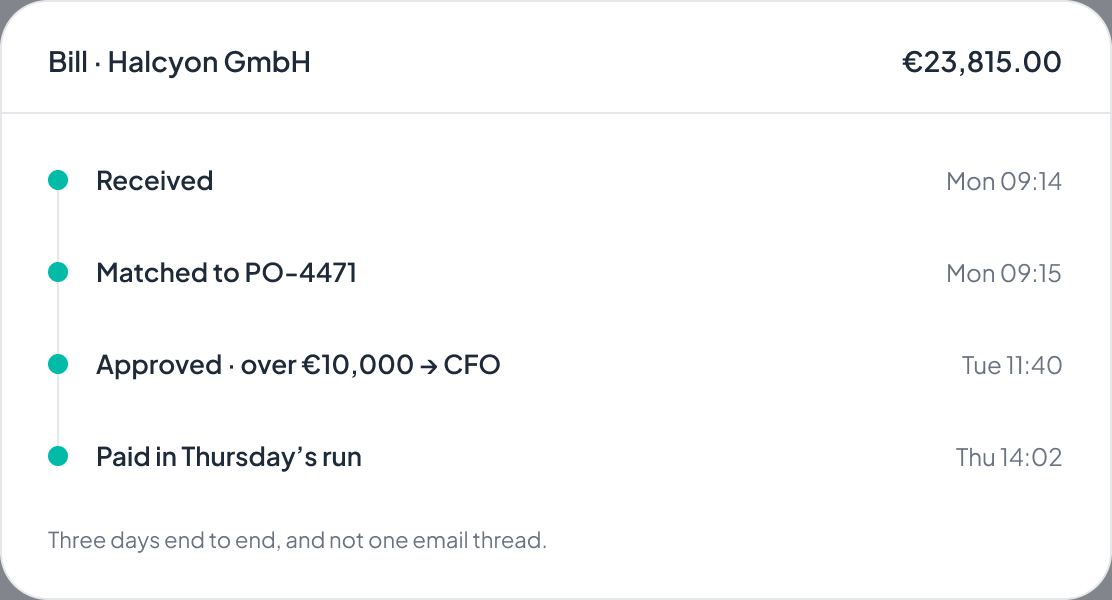
Supplier bills, approved and paid in one run.
Bills arrive, get read and route to the right approver by threshold.A single payment run clears the queue, and every payment carries its coding with it.
€1.2M in duplicate payments caught
Halcyon, in the first year on Finly.

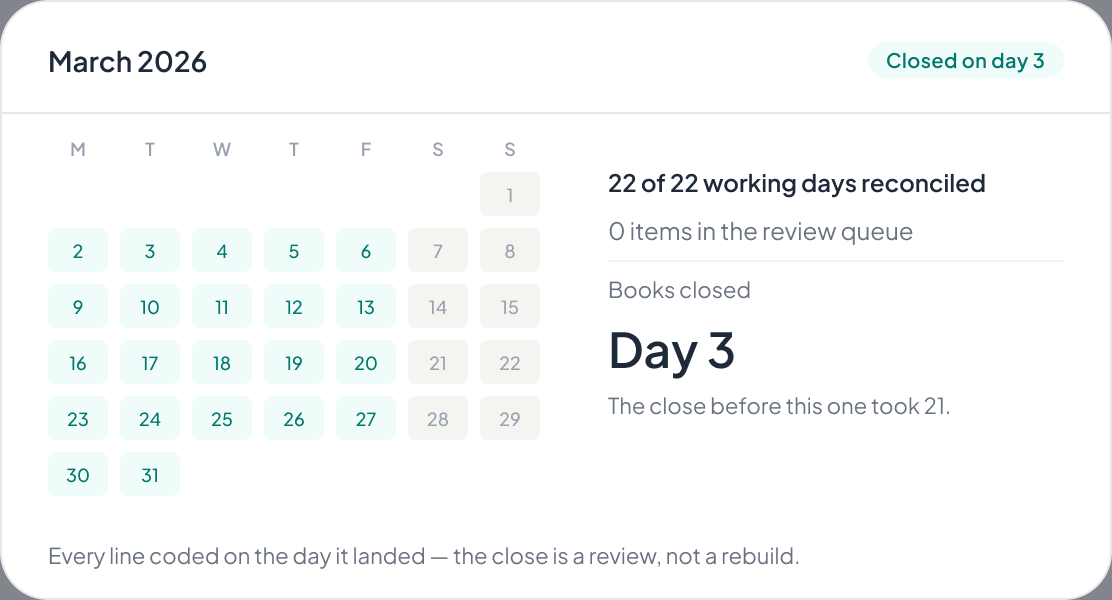
A close that starts on day one.
Every transaction is coded and matched against the bank feed as it lands.At month end there is a review queue rather than a reconstruction.
Day 21 → day 3
Northwind's close time, before and after.

Somewhere in this building, someone is exporting three files to answer one question.
Against the status quo
You already have a system. It is a spreadsheet.
Not a competitor —the thing you are actually doing today.A shared card, an inbox of receipts and a workbook that gets rebuilt every month.
| Spreadsheets and a shared card | ||
|---|---|---|
| Issuing a card | One shared card, or a personal card and an expense claim afterwards. | A card per person or per vendor, issued in seconds with its own limit. |
| Setting a limit | A conversation, then trust, then a surprise on the statement. | A policy on the card — merchant category, single-transaction cap, monthly ceiling. |
| Receipts | Chased by email in the week after the month has already ended. | Prompted the moment the transaction lands. 94% captured same day. |
| Coding | Typed into a workbook, then retyped into the accounting system. | Coded on capture and posted to the right account automatically. |
| Paying suppliers | An inbox thread, a manual transfer and a note to reconcile it later. | An approval queue with thresholds, then one payment run. |
| Closing the month | Day 21, if nothing goes wrong and nobody is on holiday. | Day 3, reviewing exceptions rather than rebuilding the ledger. |
| Same six jobs. One place to do them. | ||
Where Finly sits
Finly sits between your bank and your books.
It replaces neither.Bank feeds come in, coded entries go out, and nothing gets typed twice on the way through.
Your bank
- Balances and transactions
- Statements
- Outbound payments
payments
- Corporate cards
- Bill pay
- Close & reconciliation
One ledger. One set of numbers.
accounts
Your accounting system
- Journal entries
- Vendor bills
- Chart of accounts
Your operating account stays where it is. Finly sits alongside it — issuing, capturing and coding — and writes finished entries into your ledger.
Integrations
It already talks to your stack.
Bank feeds, accounting ledgers, payroll and HR systems sync both ways —so the numbers you see here are the numbers in your books.
- Stripe
- PayPal
- Square
- Shopify
- Wise
- Mercury
- Brex
- Ramp
- Workday
- Remote
- Greenhouse
- Lattice
- HubSpot
- Slack
- Zapier
- Coinbase
Customer story
What our customers are saying
“We used to find out what March cost us in the third week of April. Now the number moves while the month is still happening — which means we can still do something about it.”

Priya Raghavan
VP Finance
Day 21 → day 3
Read the Northwind story“We caught duplicate payments in review that would have gone out the door — twice in the first quarter, both to the same supplier under two spellings of its name. The approval queue is the only reason anyone looked.”

Tobias Reinhardt
CFO
Day 19 → day 4
Read the Halcyon story“The payment run used to be a spreadsheet, a bank portal and three people confirming totals to each other. Now it is one screen and one approval — and the invoice is already attached by the time the payment posts.”

Marta Nowak
Financial Controller
11 days back a year
Read the Kestrel story“Receipts stopped being a chase. They arrive matched, or they arrive flagged — and the flagged ones are a list I can finish before lunch instead of a month I have to reconstruct.”

Bram de Vries
Head of Finance
94% receipt capture
Read the Ostrom storyFAQ
Questions finance teams ask us first.
Everything else lives in the docs, or ask us directly —a real person answers.
How long does implementation take?
Do we have to move our banking?
Which accounting systems do you sync with?
How are customer funds protected?
Can we set different rules per entity?
What happens to our historical data?

Get started
Stop closing the month in arrears.
Book a 30-minute demo and we'll run your own last month through a sandbox, so you can see the close before you commit to anything.